YEJA Series AC Electromagnetic Brake Three Phase Motor
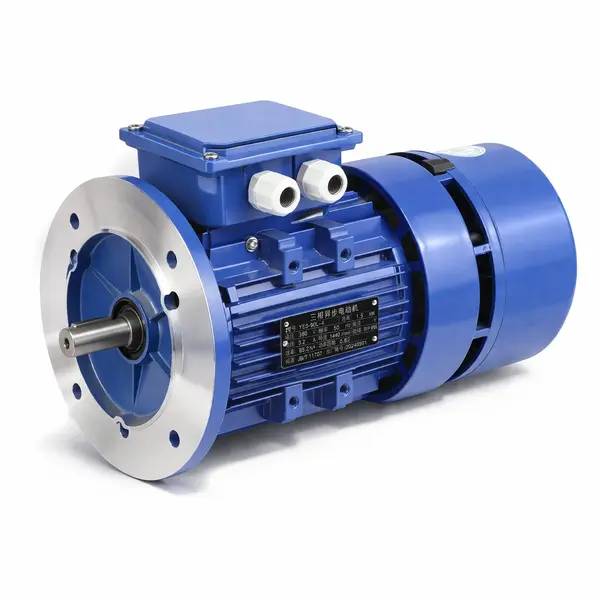
The YEJA electromagnetic brake AC gear motor integrates a spring-applied, electrically-released DC brake into a standard Y2 three-phase platform. Covering 0.18 to 45 kW in 2/4/6/8-pole configurations, it delivers controlled stopping in under 0.15 seconds with static holding torque up to 160 N.m — the standard choice for hoists, conveyors, packaging lines, and CNC tool changers where coasting is not an option.
Product Overview: Why Braking Matters
A standard three-phase induction motor has no mechanism to stop the shaft when power is removed. It coasts — the rotor decelerates under friction and windage losses alone, taking anywhere from half a second to several seconds depending on the load inertia. In applications where a hoist is holding a suspended load, a conveyor is feeding parts into a cutting station, or a turntable is indexing to the next tool position, that coasting period is unacceptable. The load drifts, the position is lost, and in the worst case, gravity takes over.
The YEJA series AC gear motor solves this by integrating a DC electromagnetic brake directly onto the rear shaft of a standard Y2 series three-phase squirrel-cage motor. The brake is spring-applied and electrically released — a fail-safe architecture meaning the shaft is clamped by default. Only when the motor is energized does the brake coil pull the armature plate away from the friction disc, freeing the shaft to rotate. The moment power is cut — intentionally or through a fault — the springs instantly push the armature back against the disc, stopping the shaft through friction within a fraction of a second.
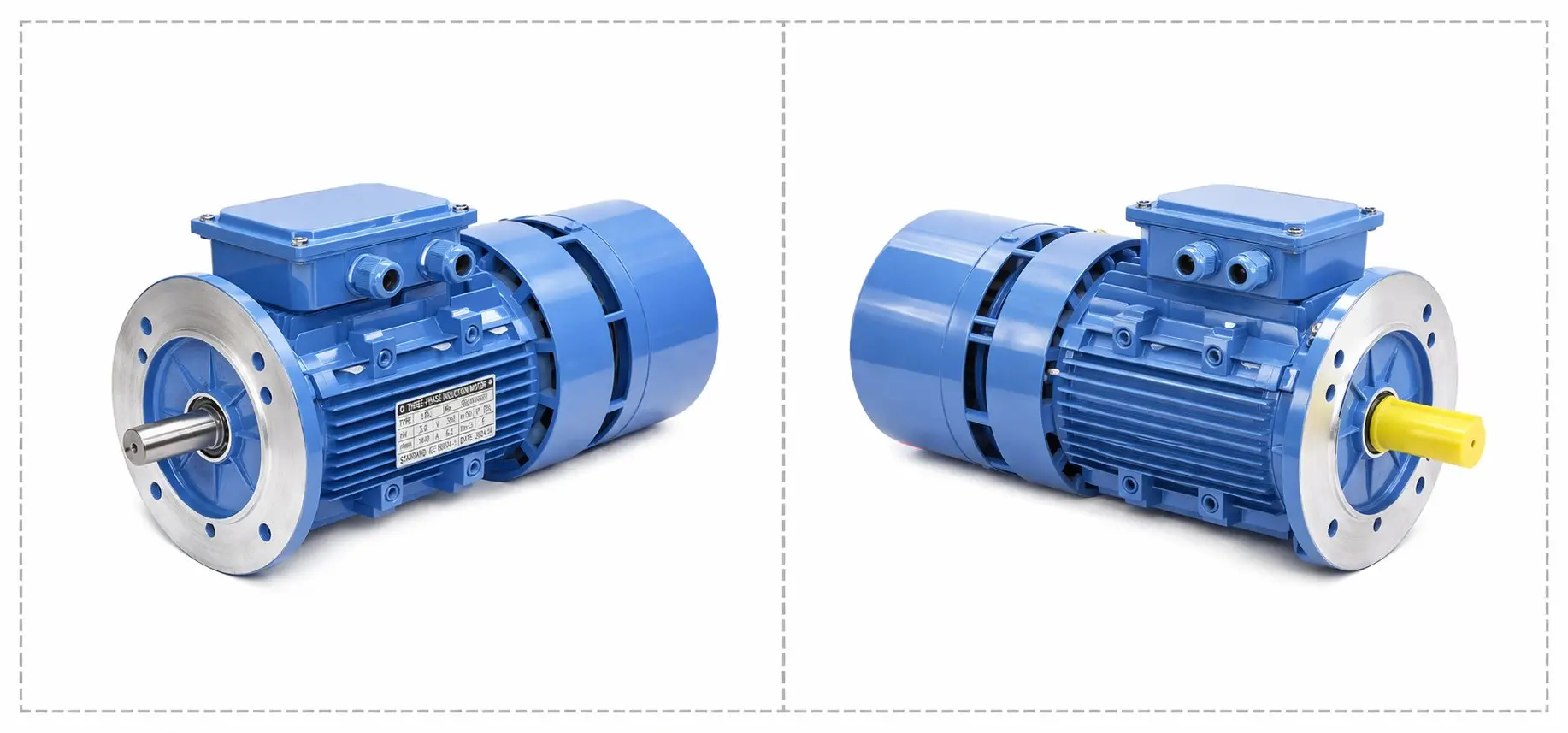
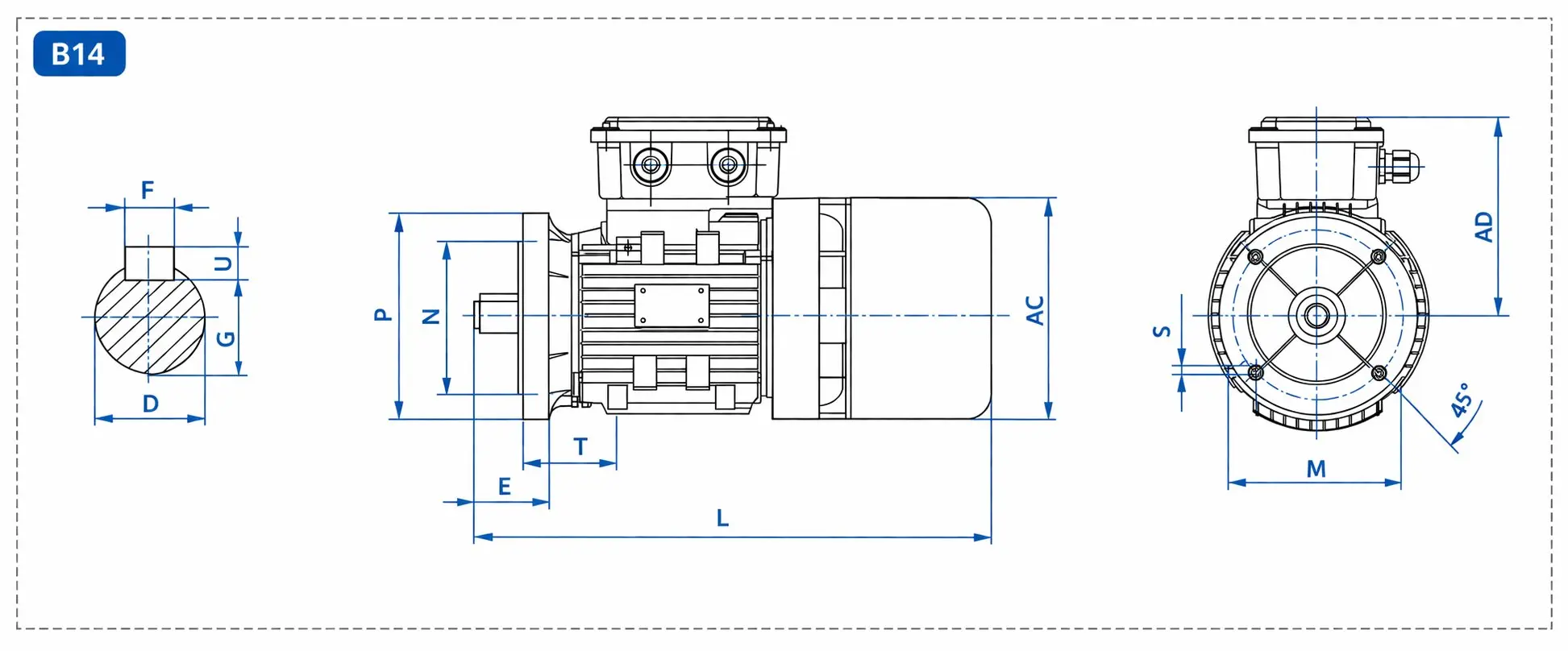
The motor side is built on the proven Y2 platform — IP54 ingress protection, Class F insulation (155 °C thermal limit), IC411 self-fan cooling. The brake side uses the AZML series spring-applied DC electromagnetic brake, connected to the motor shaft through a spline coupling. Frame sizes span 63 to 225, covering output power from 0.18 kW to 45 kW across 2-pole, 4-pole, 6-pole, and 8-pole configurations. Static braking torque ranges from 3.5 N·m on frame 63 up to 200 N·m on frame 225. Every IEC mounting dimension is preserved — the YEJA drops into any existing IEC motor mount of the same frame size. The only dimensional difference is a slight increase in overall length to accommodate the brake module at the non-drive end.
Technical Specifications
The performance table below lists all YEJA models across four pole counts. Rated output, full-load current, efficiency, power factor, starting torque ratio, maximum torque ratio, and starting current ratio are provided for every frame size. Scroll horizontally on mobile devices.
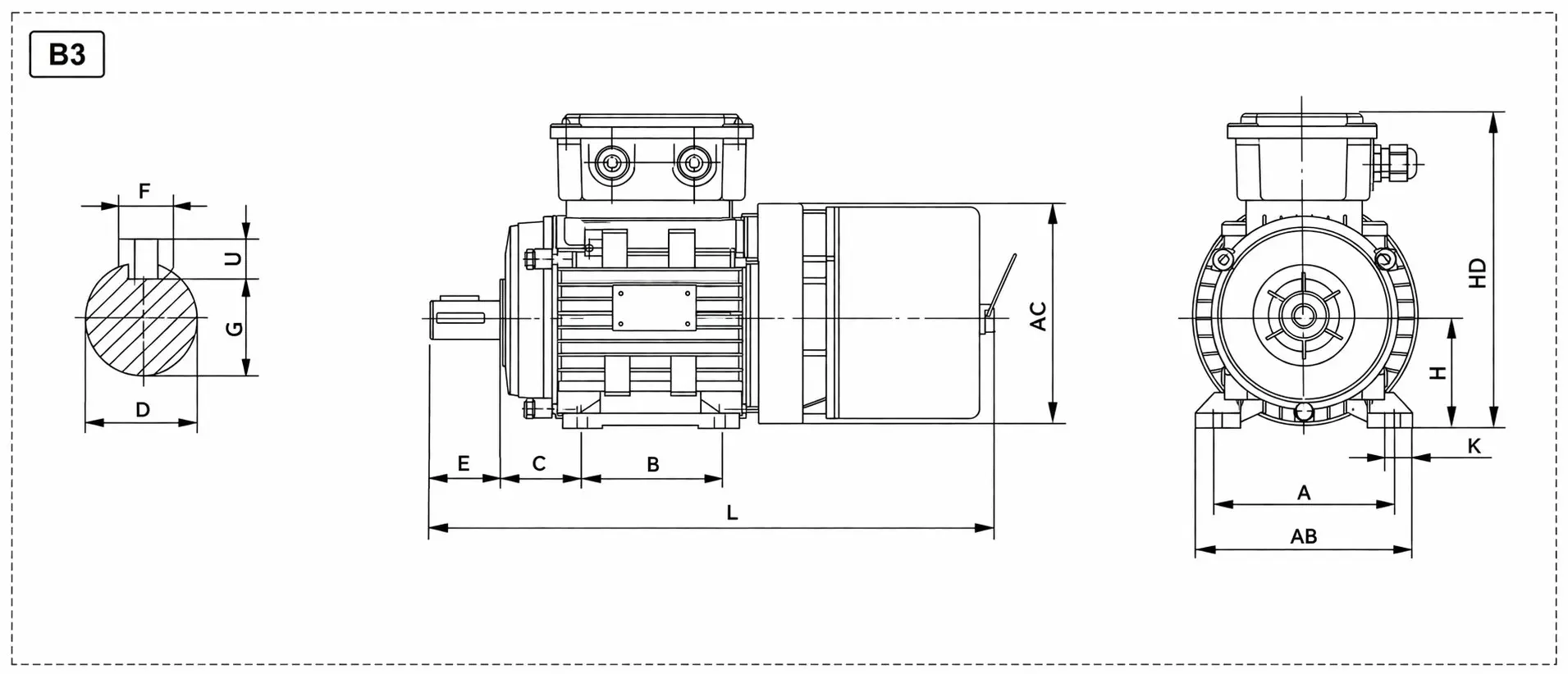
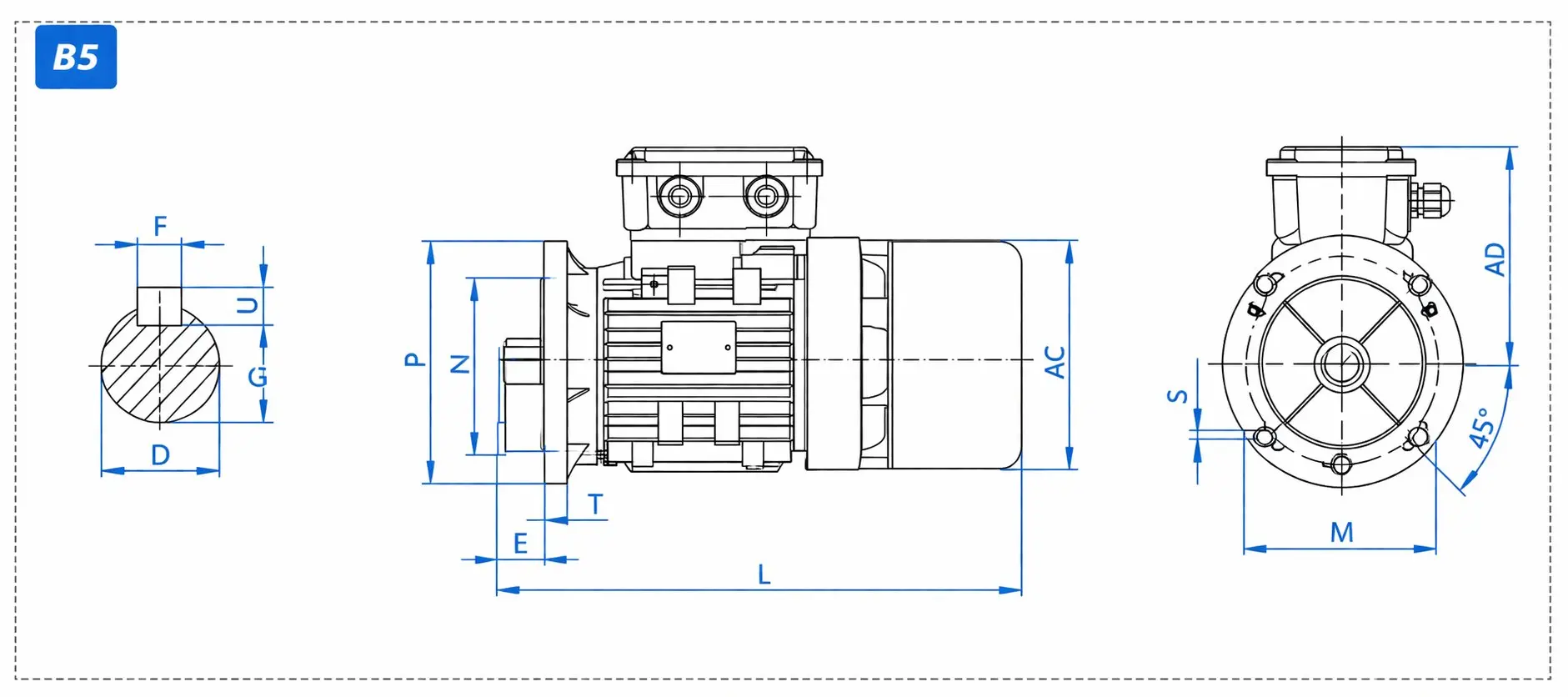
| Model | kW | HP | Speed (r/min) |
EFF η(%) |
Power Factor |
Current (A) |
Tst/Tn | Tmax/Tn | Ist/In |
|---|---|---|---|---|---|---|---|---|---|
| 2-Pole — Synchronous Speed 3000 r/min, 50 Hz | |||||||||
| YEJ-80M1-2 | 0.75 | 1 | 2870 | 75.0 | 0.84 | 1.81 | 2.2 | 2.3 | 6.5 |
| YEJ-80M2-2 | 1.1 | 1.5 | 2870 | 76.2 | 0.86 | 2.55 | 2.2 | 2.3 | 7.0 |
| YEJ-90S-2 | 1.5 | 2 | 2885 | 78.5 | 0.85 | 3.42 | 2.2 | 2.3 | 7.0 |
| YEJ-90L-2 | 2.2 | 3 | 2885 | 81.0 | 0.86 | 4.80 | 2.2 | 2.3 | 7.0 |
| YEJ-100L-2 | 3 | 4 | 2875 | 82.6 | 0.87 | 6.34 | 2.2 | 2.3 | 7.0 |
| YEJ-112M-2 | 4 | 5.5 | 2900 | 84.2 | 0.87 | 8.30 | 2.2 | 2.3 | 7.0 |
| YEJ-132S1-2 | 5.5 | 7.5 | 2930 | 85.7 | 0.88 | 11.1 | 2.0 | 2.3 | 7.0 |
| YEJ-132S2-2 | 7.5 | 10 | 2925 | 87.0 | 0.88 | 14.9 | 2.0 | 2.3 | 7.0 |
| YEJ-160M1-2 | 11 | 15 | 2940 | 88.4 | 0.88 | 21.5 | 2.0 | 2.3 | 7.0 |
| YEJ-160M2-2 | 15 | 20 | 2940 | 89.4 | 0.88 | 29.0 | 2.2 | 2.3 | 7.0 |
| YEJ-160L-2 | 18.5 | 25 | 2940 | 90.0 | 0.89 | 35.1 | 2.2 | 2.3 | 7.0 |
| YEJ-180M-2 | 22 | 30 | 2960 | 90.5 | 0.89 | 41.5 | 2.2 | 2.3 | 7.0 |
| YEJ-200L1-2 | 30 | 40 | 2960 | 91.4 | 0.89 | 56.0 | 2.2 | 2.3 | 7.0 |
| YEJ-200L2-2 | 37 | 50 | 2960 | 92.0 | 0.89 | 68.7 | 2.2 | 2.3 | 7.0 |
| YEJ-225M-2 | 45 | 60 | 2965 | 92.5 | 0.89 | 83.1 | 2.2 | 2.3 | 7.0 |
| 4-Pole — Synchronous Speed 1500 r/min, 50 Hz | |||||||||
| YEJ-80M1-4 | 0.55 | 0.75 | 1420 | 71.0 | 0.76 | 1.55 | 2.4 | 2.3 | 6.0 |
| YEJ-80M2-4 | 0.75 | 1 | 1420 | 73.0 | 0.76 | 2.05 | 2.3 | 2.3 | 6.0 |
| YEJ-90S-4 | 1.1 | 1.5 | 1425 | 76.2 | 0.78 | 2.81 | 2.3 | 2.3 | 6.5 |
| YEJ-90L-4 | 1.5 | 2 | 1425 | 78.5 | 0.79 | 3.68 | 2.3 | 2.3 | 6.5 |
| YEJ-100L1-4 | 2.2 | 3 | 1445 | 81.0 | 0.82 | 5.03 | 2.2 | 2.3 | 7.0 |
| YEJ-100L2-4 | 3 | 4 | 1445 | 82.6 | 0.81 | 6.81 | 2.2 | 2.3 | 7.0 |
| YEJ-112M-4 | 4 | 5.5 | 1450 | 84.2 | 0.82 | 8.80 | 2.2 | 2.3 | 7.0 |
| YEJ-132S-4 | 5.5 | 7.5 | 1460 | 85.7 | 0.84 | 11.6 | 2.2 | 2.3 | 7.0 |
| YEJ-132M-4 | 7.5 | 10 | 1460 | 87.0 | 0.85 | 15.4 | 2.2 | 2.3 | 7.0 |
| YEJ-160M-4 | 11 | 15 | 1470 | 88.4 | 0.84 | 22.5 | 2.2 | 2.3 | 7.0 |
| YEJ-160L-4 | 15 | 20 | 1470 | 89.4 | 0.85 | 30.0 | 2.2 | 2.3 | 7.0 |
| YEJ-180M-4 | 18.5 | 25 | 1470 | 90.0 | 0.86 | 36.3 | 2.0 | 2.3 | 7.0 |
| YEJ-180L-4 | 22 | 30 | 1470 | 90.5 | 0.86 | 42.9 | 2.0 | 2.3 | 7.0 |
| YEJ-200L-4 | 30 | 40 | 1470 | 91.4 | 0.87 | 57.3 | 2.0 | 2.3 | 7.0 |
| YEJ-225S-4 | 37 | 50 | 1480 | 92.0 | 0.87 | 70.2 | 1.9 | 2.3 | 7.0 |
| YEJ-225M-4 | 45 | 60 | 1485 | 92.5 | 0.88 | 84.0 | 1.9 | 2.3 | 7.0 |
| 6-Pole — Synchronous Speed 1000 r/min, 50 Hz | |||||||||
| YEJ-90S-6 | 0.75 | 1 | 945 | 69.0 | 0.70 | 2.36 | 2.0 | 2.2 | 5.5 |
| YEJ-90L-6 | 1.1 | 1.5 | 945 | 72.0 | 0.72 | 3.22 | 2.0 | 2.2 | 5.5 |
| YEJ-100L-6 | 1.5 | 2 | 950 | 76.0 | 0.74 | 4.05 | 2.0 | 2.2 | 6.0 |
| YEJ-112M-6 | 2.2 | 3 | 955 | 79.0 | 0.74 | 5.72 | 2.0 | 2.2 | 6.0 |
| YEJ-132S-6 | 3 | 4 | 970 | 81.0 | 0.76 | 7.40 | 2.0 | 2.2 | 6.5 |
| YEJ-132M1-6 | 4 | 5.5 | 970 | 82.0 | 0.77 | 9.63 | 2.0 | 2.2 | 6.5 |
| YEJ-132M2-6 | 5.5 | 7.5 | 970 | 84.0 | 0.78 | 12.8 | 2.0 | 2.2 | 6.5 |
| YEJ-160M-6 | 7.5 | 10 | 975 | 86.0 | 0.78 | 17.0 | 2.0 | 2.2 | 6.5 |
| YEJ-160L-6 | 11 | 15 | 975 | 87.5 | 0.78 | 24.5 | 2.0 | 2.2 | 6.5 |
| YEJ-180L-6 | 15 | 20 | 980 | 89.0 | 0.81 | 31.6 | 1.8 | 2.2 | 6.5 |
| YEJ-200L1-6 | 18.5 | 25 | 980 | 90.0 | 0.83 | 37.6 | 1.8 | 2.2 | 6.5 |
| YEJ-200L2-6 | 22 | 30 | 980 | 90.0 | 0.83 | 44.7 | 1.8 | 2.2 | 6.5 |
| YEJ-225M-6 | 30 | 40 | 985 | 91.5 | 0.85 | 58.6 | 1.7 | 2.2 | 6.5 |
| 8-Pole — Synchronous Speed 750 r/min, 50 Hz | |||||||||
| YEJ-132S-8 | 2.2 | 3 | 705 | 80.5 | 0.71 | 5.85 | 2.0 | 2.0 | 5.5 |
| YEJ-132M-8 | 3 | 4 | 705 | 82.0 | 0.72 | 7.72 | 2.0 | 2.0 | 5.5 |
| YEJ-160M1-8 | 4 | 5.5 | 720 | 84.0 | 0.73 | 9.91 | 2.0 | 2.0 | 6.0 |
| YEJ-160M2-8 | 5.5 | 7.5 | 725 | 85.0 | 0.74 | 13.3 | 2.0 | 2.0 | 6.0 |
| YEJ-160L-8 | 7.5 | 10 | 725 | 86.0 | 0.75 | 17.7 | 2.0 | 2.0 | 5.5 |
| YEJ-180L-8 | 11 | 15 | 725 | 87.5 | 0.77 | 24.8 | 1.7 | 2.0 | 6.0 |
| YEJ-200L-8 | 15 | 20 | 730 | 88.0 | 0.76 | 34.1 | 1.8 | 2.0 | 6.0 |
| YEJ-225S-8 | 18.5 | 25 | 730 | 89.5 | 0.76 | 41.3 | 1.7 | 2.0 | 6.0 |
| YEJ-225M-8 | 22 | 30 | 730 | 90.0 | 0.78 | 47.6 | 1.8 | 2.0 | 6.0 |
⚙ Braking Physics and Stopping Distance Calculation
Understanding how the electromagnetic brake arrests a rotating shaft requires two physical quantities: the kinetic energy stored in the spinning rotor-plus-load system, and the friction torque the brake disc can apply. The rotor stores rotational kinetic energy equal to ½ × J × ω², where J is the total moment of inertia (motor rotor plus coupled load, in kg·m²) and ω is the angular velocity in radians per second. When the brake engages, the friction disc applies a constant braking torque Tb. The deceleration time tstop is then:
tstop = J × ω / Tb
For example, consider a YEJA-132M-4 driving a packaging conveyor through a worm gear reducer. The motor rotor inertia is approximately 0.025 kg·m². The load inertia referred to the motor shaft (after the gearbox ratio) is 0.015 kg·m². Total J = 0.040 kg·m². At 1460 rpm the angular velocity ω = 152.9 rad/s. The static braking torque for frame 132 is 80 N·m. Applying the formula: tstop = 0.040 × 152.9 / 80 = 0.076 seconds. The conveyor stops in under 80 milliseconds — fast enough to hold position within a few millimeters of the target.
In crane and hoist applications, the critical calculation is the stopping distance under load. If a hoist drum is lowering a 2-tonne pallet at 0.3 m/s when power is cut, the YEJA brake must not only stop the drum but hold it against the gravitational torque. The static braking torque must exceed the load torque by a safety factor of at least 1.5 (EN 60204-32 recommendation). On the YEJA-160L-4, the static braking torque of 120 N·m exceeds the typical hoist drum torque at rated capacity, providing the required safety margin without an external mechanical brake.
How the Electromagnetic Brake Works
Spring-Applied, Electrically-Released Architecture
The AZML brake module bolted to the YEJA rear end shield contains four functional components: a set of compression springs, an armature plate, a friction disc spline-coupled to the motor shaft, and an electromagnetic coil cast into an annular housing. In the de-energized state, the springs push the armature plate against the friction disc, which is sandwiched between the armature and the motor end shield. The resulting clamping force generates friction torque that locks the shaft.
When the motor contactor closes, a built-in full-wave bridge rectifier — mounted inside the motor terminal box — converts the incoming AC supply to DC. The DC current energizes the brake coil. The magnetic field pulls the armature plate away from the friction disc against the spring force, creating an air gap of 0.2 to 0.5 mm (depending on frame size). With the friction disc free on both faces, the motor shaft spins without drag. No-load brake release time ranges from 0.03 seconds on frame 80 to 0.12 seconds on frame 225.
Power-Off Braking Sequence
When the motor power is switched off, the brake coil loses its DC supply within one half-cycle of the AC waveform (10 ms at 50 Hz). The electromagnetic holding force collapses. The compression springs immediately push the armature against the friction disc. The shaft decelerates under the braking torque. Total no-load braking time — from power removal to zero speed — ranges from 0.04 seconds on small frames to 0.15 seconds on the largest frames. Under load, the actual stopping time depends on the total system inertia as calculated above.
⚖ Brake Technology Comparison: YEJA vs DC Brake vs Hydraulic
| Parameter | YEJA (AC Electromagnetic) | YEJ2 (DC Electromagnetic) | Hydraulic Disc Brake |
|---|---|---|---|
| Brake Power Supply | Same AC as motor (built-in rectifier) | Separate DC 99 V / 170 V (external rectifier) | Hydraulic power unit required |
| Fail-Safe | Yes — spring-applied | Yes — spring-applied | Depends on accumulator design |
| No-Load Braking Time | 0.04 – 0.15 s | 0.15 – 0.45 s | 0.5 – 2.0 s (valve response) |
| Braking Torque Range | 3.5 – 200 N·m | 5 – 400 N·m | 50 – 50,000+ N·m |
| Wiring Complexity | Low — single cable, same as motor | Medium — separate DC supply cable | High — hydraulic lines + power unit |
| Disc Life (cycles) | ≥ 1,000,000 | ≥ 1,000,000 | ≥ 500,000 (pad-dependent) |
| Maintenance | Air gap check every 6 months | Air gap check + rectifier inspection | Fluid level, filter, seal inspection |
| Best Suited For | Conveyors, packaging, light hoists ≤ 45 kW | Machine tools, larger hoists ≤ 45 kW | Heavy cranes, presses, high-inertia loads |
The YEJA's primary advantage over the YEJ2 series is wiring simplicity: the brake shares the motor's AC power supply and does not require a separate DC rectifier cabinet. This reduces installation cost and eliminates a potential failure point. Compared to hydraulic brakes, the YEJA offers faster response, lower maintenance, and a dramatically simpler installation — at the trade-off of a lower maximum braking torque ceiling. For most industrial applications below 45 kW, the electromagnetic brake provides the optimal balance of response speed, reliability, and cost.
⚙ Friction Disc Lifecycle Analysis
The AZML brake friction disc is a sintered metal composite bonded to a steel carrier plate. It is rated for a minimum of 1,000,000 braking cycles under standard conditions (rated speed, rated inertia, no-load braking). In practice, disc life depends on four variables: the energy absorbed per braking event, the braking frequency, the ambient temperature, and the air gap setting.
Energy per braking event equals ½ × J × ω². A YEJA-112M-4 at 1450 rpm with a total reflected inertia of 0.02 kg·m² absorbs approximately 0.02 × (151.8)² / 2 = 230 joules per stop. At 60 stops per hour, 16 hours per day, 300 days per year, the disc accumulates 86.4 million joules annually. The disc material is typically rated for a cumulative energy absorption of 10⁸ to 10⁹ joules before replacement is needed — giving a projected service life of 1 to 10 years depending on the application duty.
The critical wear indicator is the brake air gap. As the friction material wears, the air gap between the armature and the brake body increases. When the gap exceeds the maximum specified value (typically 0.4 to 0.6 mm depending on frame size), the electromagnetic holding force can no longer fully retract the armature, and the motor may start with residual brake drag — generating heat, accelerating wear, and eventually burning out the brake coil. Regular air gap measurement with a feeler gauge is the single most important maintenance task for the YEJA.
🔧 Brake Air Gap Adjustment: Step-by-Step
The AZML brake uses three (frames 63–112) or six (frames 132–225) adjustment screws evenly spaced around the brake circumference. Each screw has a lock nut. The procedure is as follows:
- Disconnect power — Verify zero voltage at the motor terminal box. Lock out and tag out per plant procedure.
- Remove the fan cover — The brake is located between the fan and the rear end shield. On most frames, two or four screws hold the fan cover.
- Measure the current air gap — Insert a feeler gauge between the armature plate and the brake body at each adjustment screw location. Record the readings. If any reading exceeds the maximum value listed in the motor nameplate data (typically 0.4 to 0.6 mm), adjustment is required.
- Select the target gap — Use the initial air gap value from the motor datasheet (typically 0.2 to 0.3 mm for new discs).
- Adjust — Loosen the lock nut. Insert the feeler gauge of the target thickness into the gap at the adjustment screw. Slowly screw in the adjustment screw until the feeler gauge is lightly clamped. Tighten the lock nut while holding the adjustment screw. Remove the feeler gauge. Repeat for each screw.
- Verify uniformity — The air gap at all three (or six) points must be within ±0.05 mm of each other. Uneven gaps cause the armature to tilt, resulting in partial contact, uneven wear, increased noise, and potential coil overheating.
- Reassemble and test — Replace the fan cover. Energize the motor briefly (jog). Verify that the brake releases cleanly (no scraping sound) and engages firmly when power is cut (shaft stops abruptly with no coasting).
If the friction disc is worn beyond the adjustment range — meaning the air gap cannot be brought back to the initial value even with the adjustment screws fully advanced — the disc must be replaced. Replacement discs are available as a spare part. A trained electrician can complete a disc swap in approximately 30 to 45 minutes.

Duty Cycle Selection Matrix
Not every brake motor application operates at the same intensity. The IEC defines several duty types that affect brake motor selection. Standard YEJA models are rated for S1 (continuous duty), but brake utilization varies enormously. A warehouse conveyor that starts and stops twice per minute puts very different thermal and mechanical demands on the brake than a CNC tool changer cycling 30 times per minute.
| Application | Starts/Hour | IEC Duty | Brake Thermal Load | Recommended Sizing |
|---|---|---|---|---|
| Warehouse conveyor | 60–120 | S4 (40%) | Low–Medium | Standard YEJA at rated kW |
| Packaging line indexer | 200–600 | S4 (25%) | Medium–High | Upsize one frame for brake thermal margin |
| CNC tool changer | 600–1800 | S5 | High | Upsize one frame + external forced cooling |
| Overhead crane travel | 30–60 | S3 (40%) | Low | Standard YEJA at rated kW |
| Crane hoist (vertical) | 30–60 | S3 (25%) | Medium | Verify static torque ≥ 1.5 × load torque |
| Rolling door / gate | 10–30 | S2 (30 min) | Very Low | Standard YEJA at rated kW |
When starts per hour exceed 200, the brake disc temperature rises significantly between cycles. In these high-duty applications, the recommended practice is to select the next larger frame size — not necessarily for the motor's electrical capacity, but for the brake's thermal capacity. The larger brake disc has more surface area for heat dissipation and a thicker friction pad for longer wear life. If forced cooling (an independent fan on the non-drive end) is available, it can extend the brake's thermal duty cycle by approximately 30%.
Application Scenarios
Overhead Cranes and Hoists
The fail-safe brake is mandatory on all crane hoist drives. When the operator releases the control pendant, the YEJA brake locks the drum and holds the suspended load. Static braking torque exceeds rated motor torque by a factor of 1.5 to 2.0, meeting the safety margin requirements of EN 60204-32 and FEM 9.511. For travel drives, the brake prevents the bridge or trolley from coasting after the operator stops. The YEJA-132M-4 (7.5 kW) is one of the most frequently specified models for 5-tonne single-girder cranes in Korean manufacturing plants.
Packaging and Filling Lines
On a bottle filling line, the conveyor must stop the bottles within ±2 mm of the fill nozzle position for every cycle. The YEJA-90L-4 (1.5 kW) paired with a helical gear reducer delivers the required stopping precision. At 200 bottles per minute, the brake cycles 200 times per minute — 12,000 per hour. This is a high-duty application where the brake disc temperature and air gap must be monitored regularly.

CNC Machine Tool Spindles and Turrets
Automatic tool changers and rotary indexing tables require the spindle to stop at a precise angular position — typically within 0.1° — before the tool exchange mechanism engages. The YEJA-100L1-4 (2.2 kW) offers a combination of fast braking response (under 60 ms no-load) and repeatable stopping position that makes it a cost-effective alternative to servo-driven tool changers on mid-range machining centers.
Textile Machinery
Winding and unwinding stations on textile lines use the brake motor to maintain web tension and stop the roll when the splice point arrives. The YEJA-80M2-4 (0.75 kW) is commonly paired with a planetary gearbox for this duty — the gearbox amplifies the brake torque at the roll, while the motor provides variable speed through a VFD for tension control.
Related and Complementary Products
The YEJA brake motor is rarely used in isolation — it forms part of a drive system that typically includes a speed reducer for torque multiplication and speed reduction. When paired with a cycloidal gear reducer, the YEJA delivers high reduction ratios (6:1 to 87:1) in a compact footprint suited to conveyor drives and material handling equipment. The cycloidal reducer's shock-load tolerance complements the brake motor's precise stopping capability, creating a robust package for intermittent-duty applications like palletizers and case erectors. 
For applications demanding higher efficiency and lower backlash, a helical or bevel-helical gearbox is the preferred match. Helical gears offer 96–98% efficiency per stage versus 85–92% for worm gears, which matters in high-cycling brake motor applications where every watt of heat in the drive train adds to the brake disc's thermal burden. Where the YEJA is used with a VFD for variable speed, ensure that the VFD's DC injection braking feature is disabled — the electromagnetic brake handles all mechanical stopping, and dual-braking can cause destructive torque spikes.
Same-Series Alternatives: If the application requires explosion-proof braking, consider the YBBP variable frequency explosion proof motor combined with an external brake module. For higher braking torque above 200 N·m, the YEJ2 series with its separate DC power supply offers larger brake sizes up to frame 225 with torques exceeding 400 N·m.
Frequently Asked Questions
Can the YEJA be used with a variable frequency drive (VFD)?
Yes, but with one precaution. The built-in rectifier that powers the brake coil draws its AC input from the motor terminal box. When running on a VFD at reduced frequency, the rectifier output voltage drops, potentially weakening the brake release force. For sustained operation below 25 Hz, use an independent 380 V AC supply for the brake rectifier, bypassing the VFD output. Most VFD manufacturers offer a dedicated brake relay output for this purpose.
What is the rated disc life?
The AZML friction disc is rated for a minimum of 1,000,000 braking cycles under standard conditions (rated speed, rated motor inertia, no external load inertia). In practice, applications with high external inertia or high braking frequency will consume the disc faster. Monitor the air gap at 6-month intervals — when it reaches the maximum specified value and cannot be adjusted further, replace the disc.
How do I know when to replace the friction disc?
Replace when the air gap exceeds the maximum value in the maintenance manual (typically 0.4 to 0.6 mm depending on frame size) and cannot be reduced by adjusting the screws. Secondary indicators include increased braking time, increased brake noise, and visible scoring on the disc surface.
Is the YEJA available with an aluminum housing?
Standard production uses cast-iron housing (Y2 platform) for frames 80 and above. Frame 63 and 71 are available in aluminum. Aluminum-housing versions for larger frames are available as a special order with a 4–6 week lead time.
Can I retrofit an existing Y2 motor with the AZML brake?
Not recommended. The YEJA is factory-assembled with the brake spline-coupled to the motor shaft and the rectifier pre-wired. Field retrofitting requires precise shaft machining, spline tolerance verification, and rectifier mounting — it is more cost-effective to replace the entire motor with a YEJA unit.
What voltage does the brake coil operate at?
The built-in rectifier converts the motor supply AC to DC. For motors up to 3 kW, the rectifier converts 220 V AC to approximately 99 V DC. For motors 4 kW and above, the rectifier converts 380 V AC to approximately 170 V DC. No external DC power supply is needed.
Customer Reviews
Kim Hyun-soo, Production Manager, Gyeonggi-do (early 2025)
"The YEJA-100L1-4 on our packaging conveyor stops within 3 mm every cycle. Over 200,000 cycles, no visible brake disc wear. We measured the air gap at the last shutdown — still at 0.25 mm, well within spec."
Park Won-tae, Crane Operator, Busan (mid 2024)
"Replaced the brake motor on our 5-ton crane with YEJA-132M-4. The brake holds solid under full load. No drift — I can leave a pallet suspended and walk away for a tool without worry."
Lee Ji-eun, Automation Engineer, Changwon (late 2024)
"CNC tool changer application. The YEJA-90L-4 stops the turret in under 0.1 seconds. Repeatability is excellent — we measured positioning error at less than 0.05° over 10,000 consecutive cycles."
Shin Hye-jin, Procurement Specialist, Daegu (mid 2025)
"Ordered 8 brake motors for a warehouse conveyor. Delivery was 11 days. Pricing was about 40% below the European equivalent. All 8 units passed incoming inspection and went into service without rework."
Yoon Sang-woo, Maintenance Supervisor, Incheon (early 2025)
"We run YEJA-112M-4 units on four textile winding stations, cycling about 300 times per hour. After eight months, the air gaps are still within initial tolerance. The built-in rectifier design saves us a panel-mount rectifier on each motor — four fewer components to maintain."
Packing and Shipping

Additional information
| Editor | Cxm |
|---|
Related products
-
YBX3 Series Explosion Proof Three Phase Asynchronous Motor
-

YBBP Explosion Proof Variable Frequency Three Phase AC Gear Motor
-
YE4/IE4 Super Premium Efficiency Three Phase AC Gear Motor
-
YE3/IE3 Premium Efficiency AC Gear Motor | Three Phase Motor
-
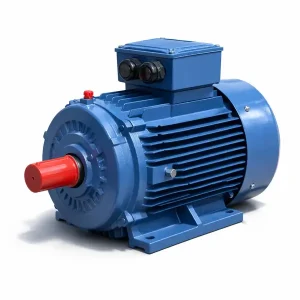
YE2 IE2 High Efficiency AC Gear Motor | Three Phase Induction Motor
-
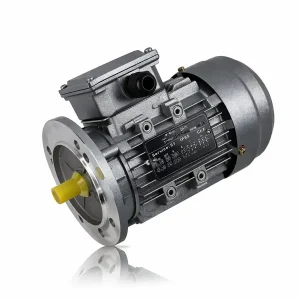
YS Aluminum AC Gear Motor | Small Power Three Phase Motor
-
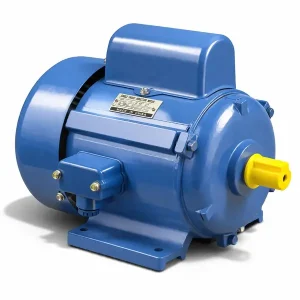
JY Single Phase AC Gear Motor | Capacitor Start Induction Motor
-
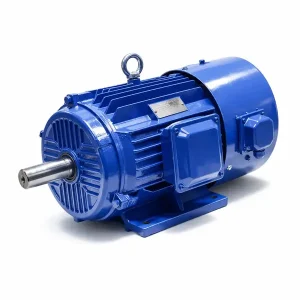
YVF2 AC Gear Motor – Variable Frequency Three Phase | Speed Control