The Machine That Never Stops Punching
A pillow-type flow wrapper is one of the hardest-working machines on any snack or bakery packaging floor. It pulls a continuous film web from a roll, forms it into a tube around the product, seals the longitudinal seam, and then uses a pair of cross-seal jaws to simultaneously cut the film and heat-seal both ends of each individual package. The cross-seal jaw assembly executes this cut-and-seal action 150 to 250 times per minute on a mid-speed machine, and up to 350 times per minute on high-speed lines running candy bars, biscuit packs, or single-serve snack portions.
Every one of those jaw closures transmits a mechanical shock pulse back through the drive train to the motor. The motor rotor accelerates the jaw arm forward, absorbs the impact of the jaw closing against the anvil, reverses the arm, and accelerates it again for the next cycle — all within 170 to 400 milliseconds depending on machine speed. Over a single 16-hour production shift, the motor experiences between 144 000 and 336 000 individual load impulses. Over a year of 300 production days, that accumulates to 43 million to 101 million cycles. No other motor application in a typical food factory comes close to this cycle count.
The motor that drives this jaw assembly must be designed for three things simultaneously: high-frequency cyclic loading without bearing fatigue, resistance to fine airborne powder that infiltrates every opening in the machine frame, and VFD compatibility for precise jaw timing synchronized to the film web speed. Our AC gear motor YVF2 series with IC416 independent cooling addresses all three challenges in a single, IEC-standard package.
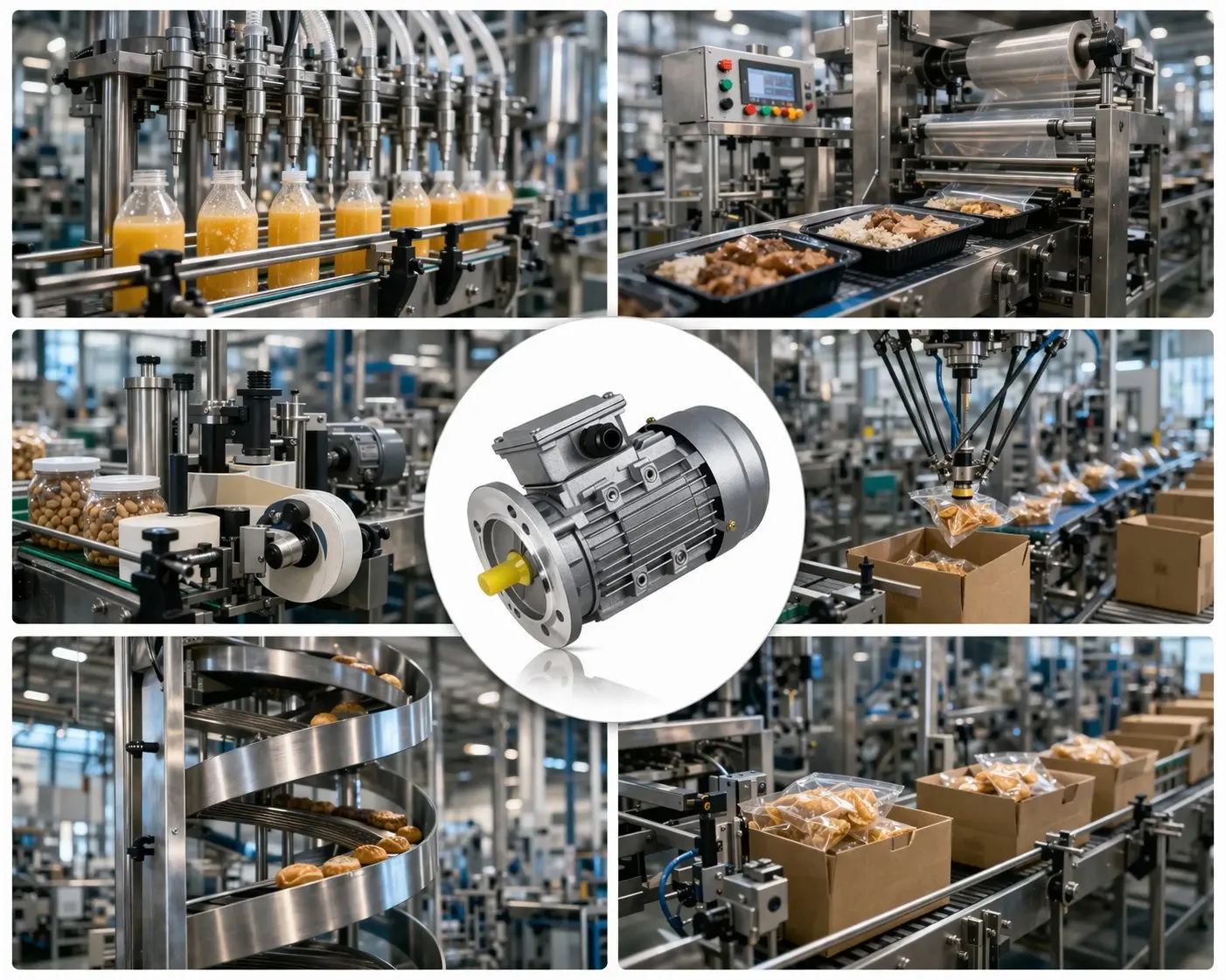
Pillow Packaging Motor Specifications
| Parameter | Specification |
|---|---|
| Recommended Series | YVF2 (primary — IC416 mandatory for dusty environments) |
| Power Range | 1.1 to 3 kW (typical jaw drive: 1.5 to 2.2 kW) |
| Poles / Speed | 4-pole / 1450 rpm base (VFD range: 10–80 Hz) |
| Efficiency | IE3 |
| Protection | IP54 + triple-lip shaft dust seal |
| Insulation | Class F (VPI treated), 1600 V peak VFD rating |
| Cooling | IC416 independent fan with filtered air intake |
| Shaft Seal | Triple-lip NBR + labyrinth pre-seal for powder environments |
| Vibration Grade | ISO 21940-11 G2.5 (G1.0 available on request) |
| Bearing Life (L10) | 25 000+ hours at rated load (C3 clearance standard) |
| Reducer Pairing | Timing belt (primary) or planetary gearbox (high-speed machines) |
Bearing Endurance Under 100-Million-Cycle Loading
Standard deep-groove ball bearings in industrial three phase motors are selected for radial load capacity and speed rating — the assumption being that the motor runs at near-constant speed with steady-state loading. Pillow packaging machines violate both assumptions. The load oscillates at 150 to 350 Hz (the jaw striking frequency), and the speed varies continuously as the VFD adjusts jaw timing. This cyclic loading introduces a fatigue mode that standard bearing life calculations (ISO 281) do not fully capture: micro-pitting on the bearing races caused by repetitive Hertzian contact stress at the same angular positions.
Our approach to bearing specification for pillow packaging motors includes three modifications beyond the standard catalog. First, we specify C3 internal clearance (larger than the default CN clearance) to accommodate the thermal expansion of the inner ring when the motor runs warm under cyclic load. Second, we use polyurea-thickened grease rather than lithium-based grease — polyurea maintains its film strength under the repetitive shock loading that pillow pack drives generate. Third, on motors above 2.2 kW, we upgrade to sealed SKF Explorer or NSK Deep Groove Zz bearings with extended grease reservoirs that postpone the re-lubrication interval from 8 000 hours to 15 000 hours. These three changes cost less than 5 percent of the motor price but typically extend the first-bearing-replacement interval from 18 months to over 36 months on a two-shift packaging line.
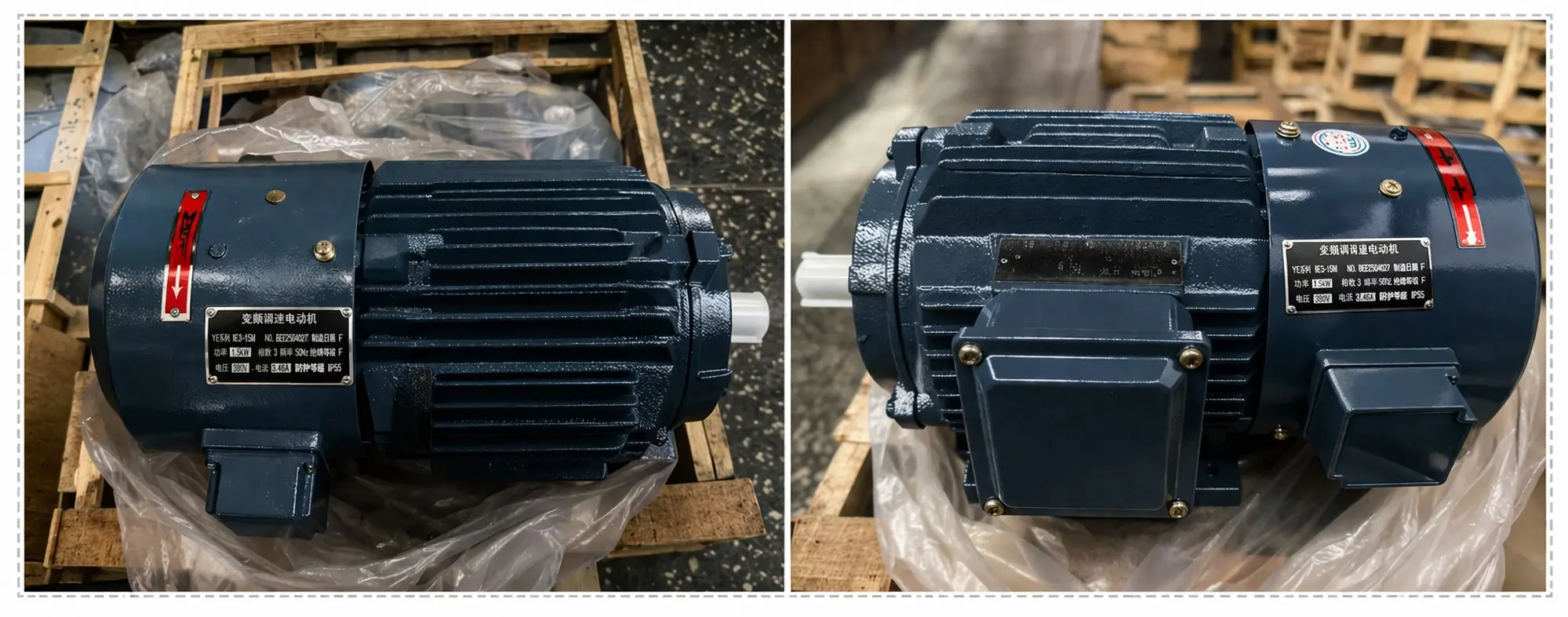
Dust Ingress: The Silent Motor Killer on Packaging Lines
Pillow packaging machines process products that shed fine airborne particles — flour dust from bread rolls, powdered sugar from confectionery, cocoa powder from chocolate bars, dried spice particles from seasoning sachets, and starch dust from rice crackers. This powder circulates inside the machine enclosure, drawn by the convection currents generated by the film sealing heaters. The motor cooling fan, by its very nature, is an air-moving device. On a standard self-cooled motor (IC0141), the shaft-mounted fan pulls ambient air — including all that powder — through the motor housing to cool the winding. Within weeks, a layer of fine powder accumulates on the stator laminations and winding end-turns. This layer acts as thermal insulation, trapping heat inside the motor and gradually raising the winding hot-spot temperature toward the insulation limit.

The progression is insidious because it is slow. The motor does not fail suddenly. Instead, the winding temperature rises by 1 to 2 degrees per month as the dust layer thickens. After 6 to 12 months, the hotspot temperature has crept 15 to 25 degrees above where it was on a clean motor, pushing the insulation into accelerated aging. The motor eventually fails on a random Tuesday afternoon — not from a single event, but from the cumulative thermal damage that began the day the dust started building up.
Our YVF2 variable frequency motor with IC416 independent cooling solves this problem architecturally. The IC416 fan is a separately housed unit that can draw air from a clean source — a filtered duct from outside the machine enclosure, or from above the dust zone — rather than from the powder-laden air inside the machine frame. The main motor housing remains sealed, with no internal airflow path for dust to follow. The cooling air passes over the external fins of the motor housing without ever entering the winding compartment. Combined with IP54 sealing and a triple-lip dust seal on the shaft extension, this keeps the winding compartment effectively dust-free for the entire service life of the motor.
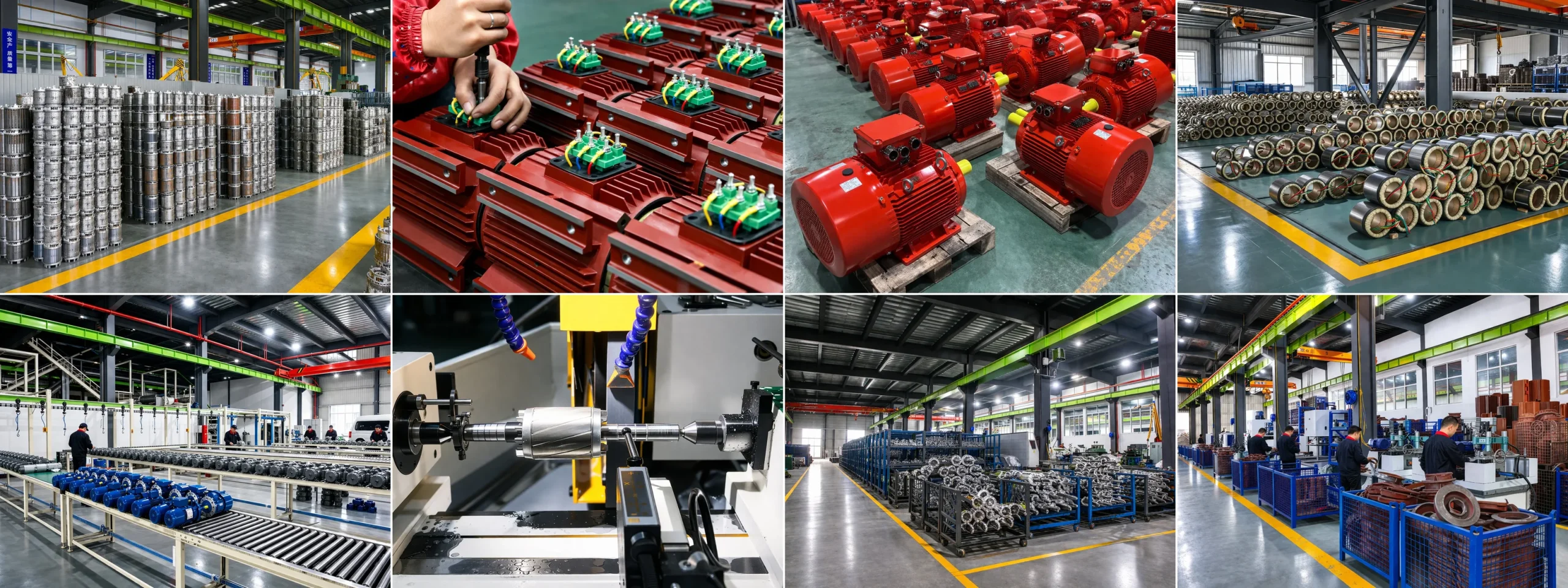
Jaw Timing Synchronization: Where Milliseconds Define Package Quality
The cross-seal jaws on a pillow wrapper must close at the exact moment the gap between two products passes through the jaw station. If the jaws close too early, they clamp down on the trailing edge of the product — crushing it, contaminating the seal area, and creating a defective package. If they close too late, the leading edge of the next product enters the jaw zone and suffers the same fate. The timing window is typically 5 to 15 milliseconds wide, depending on the gap length and the film web speed.
This timing is controlled by the VFD, which receives a trigger signal from a registration sensor that detects the product position (usually via a printed eye mark on the film, or a photoeye detecting the product gap). The VFD adjusts the jaw motor speed in real time to ensure the jaws arrive at the closure point within the timing window. The motor must respond to these speed corrections within 2 to 5 milliseconds — a dynamic response requirement that rules out simple V/f control and demands sensorless vector or closed-loop vector VFD operation.
The YVF2’s vacuum-pressure-impregnated (VPI) winding provides the low leakage inductance needed for fast current response. The 1600 V peak insulation rating handles the high dV/dt switching pulses from the VFD without partial discharge degradation, even at the 8 to 16 kHz switching frequencies used by modern high-performance drives. The result: the motor tracks the VFD speed commands with the millisecond-level response that jaw synchronization requires, cycle after cycle, shift after shift.
Core Advantages for Pillow Packaging Duty
IC416 Filtered Cooling Bypasses the Dust Zone
The independently powered cooling fan draws air from a clean source outside the machine frame, passing it over the motor housing fins without entering the sealed winding compartment. Flour, sugar, and cocoa powder never touch the stator — eliminating the gradual thermal degradation that kills standard self-cooled motors within 12 months on powder-product packaging lines.
VPI Winding for Millisecond Response
Vacuum-pressure impregnation fills all air gaps between conductors with solid resin, reducing leakage inductance and enabling the fast current response that jaw-synchronization VFD algorithms demand. The 1600 V peak insulation rating withstands high dV/dt switching pulses without partial discharge damage — even at switching frequencies up to 16 kHz.
C3 Bearings with Polyurea Grease
Engineered for the 50-to-100 million cycle fatigue life that pillow pack jaw drives impose. C3 clearance prevents thermal preload at operating temperature, polyurea grease maintains film strength under repetitive shock, and extended grease reservoirs push the re-lubrication interval beyond 15 000 hours.
IEC Bolt-In Replacement in Under 60 Minutes
Same frame dimensions as any IEC 60072 motor — Siemens, ABB, SEW, LS Electric, WEG, or any other brand. Unbolt the old motor, bolt in ours, reconnect three wires and the ground. The packaging line is back in production before the shift ends.
Compatible Brand Replacements
Brand names below are cited for cross-reference only. Our motors are independently manufactured and not affiliated with these companies.
The YVF2 replaces any IEC-frame VFD-duty induction motor in the 0.75 to 315 kW range. For pillow packaging jaw drives in the 1.1 to 3 kW band, direct replacements include Siemens 1LE1 VFD-rated, ABB M3BP inverter duty, SEW-Eurodrive DRN series, Nord SK 90-100 inverter type, WEG W22 Inverter Duty, LS Electric AEEVF, and Nidec inverter-rated platforms. The IEC frame ensures the same shaft height, foot bolt spacing, flange dimensions, and terminal box position — making the physical swap straightforward on any machine brand.
Related Drive Components

The jaw drive on most pillow wrappers uses a timing-belt transmission for clean, backlash-free power transfer from the motor to the jaw cam shaft. For machines that use gear reduction instead of belts, a planetary gearbox with less than 6 arc-minutes of backlash maintains the jaw timing accuracy that film registration demands. Product infeed conveyors feeding the wrapper typically use a worm gear reducer for cost-effective speed reduction on the feed belt, while the discharge conveyor carrying sealed packages to the cartoner may use sprocket and chain drives for their tolerance of moderate shaft misalignment in multi-section conveyor layouts.
Customer Results
“We run six pillow wrappers on our biscuit line — three shifts, 300 days a year. The old motors were standard IC0141 self-cooled units from a Korean brand. We were replacing them every 8 to 10 months because flour dust packed the fan blades and winding temperature climbed until the thermal relay tripped. After switching to YVF2 with IC416 cooling and filtered air ducted from above the production ceiling, we completed 22 months without a single motor-related stoppage across all six machines. Our maintenance budget for wrapper motors dropped by 78 percent.”
Oh Sung-hwan, Maintenance Manager
Biscuit manufacturer, Asan, Chungnam, Korea (Q3 2024)
“Our chocolate bar wrapper runs at 280 packages per minute. The jaw timing window is 8 milliseconds. After testing three motor brands, the YVF2-90S-4 gave us the most consistent jaw closure timing — measured standard deviation of 0.9 ms versus 1.6 ms on the previous motor. We attribute this to the VPI winding quality and the IC416 maintaining stable thermal conditions. Cocoa powder ingress has been zero over 14 months of service — confirmed by opening the motor for inspection during our scheduled annual shutdown.”
Wattana Supachai, Packaging Engineer
Confectionery plant, Samut Prakan, Thailand (Q1 2025)
Pillow Packaging Motor FAQ
Stop Losing Production to Dust-Killed Motors
Tell us your wrapper speed, product type, and current motor failure pattern. We specify the right YVF2 with IC416 cooling, dust seals, and bearing upgrades — so you stop replacing motors every year.
Editor: Cxm