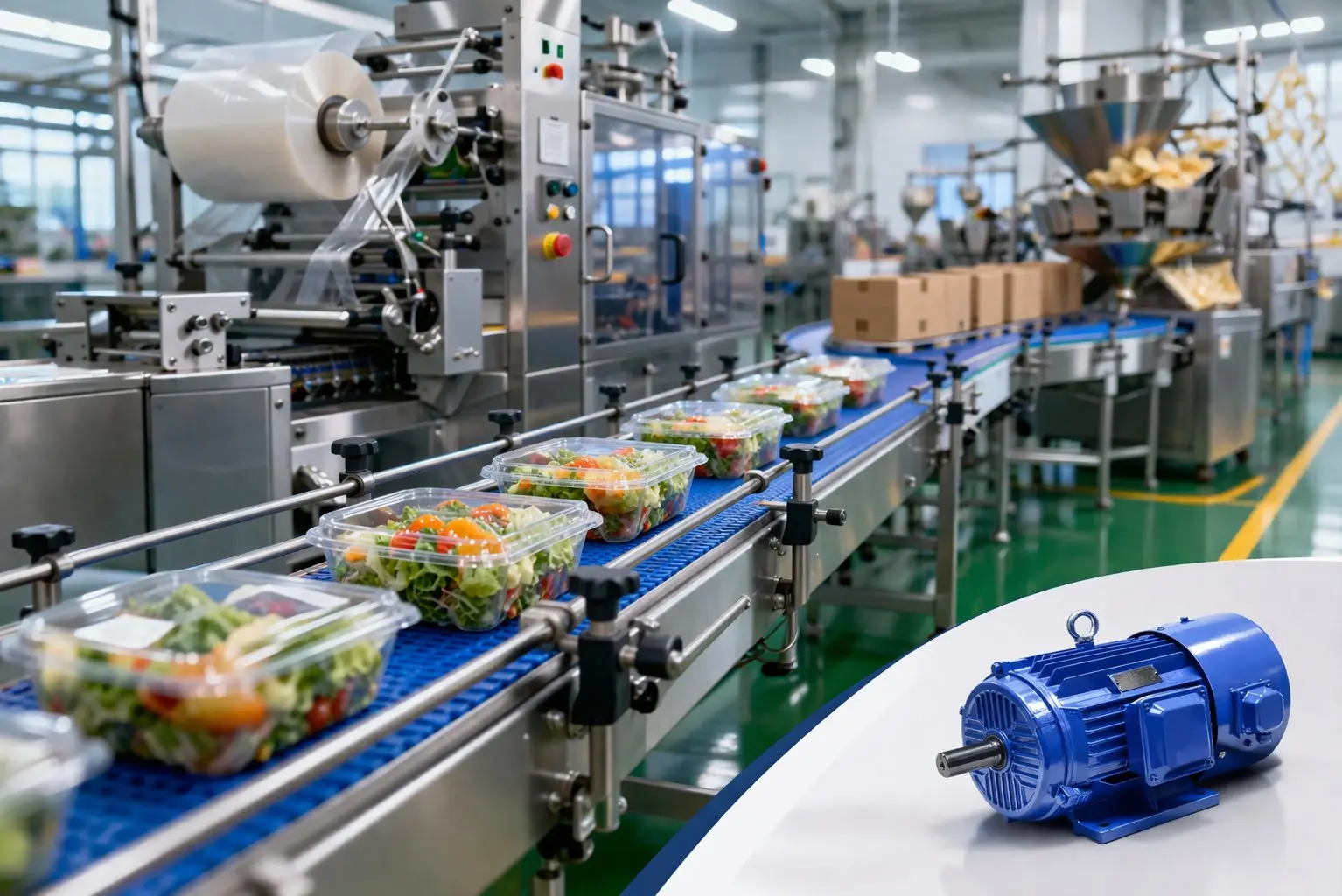
Mixing: Where Motor Torque Meets Fluid Physics
Industrial food mixing is fundamentally a battle between the motor and the product. The motor turns the impeller; the product resists. The resistance — quantified by the fluid’s viscosity — varies enormously across the food industry. Water-based beverage syrups at 5 to 50 centipoise flow with minimal effort. Tomato paste at 3 000 to 5 000 centipoise demands considerably more. Cookie dough at 50 000 to 200 000 centipoise fights the impeller with such intensity that an undersized motor stalls within the first revolution after adding the last flour charge.
The torque required to turn a mixing impeller through a viscous product follows a relationship that depends on the impeller diameter, rotational speed, product viscosity, and the geometry of the mixing vessel. As viscosity increases, the power draw rises roughly proportionally — doubling the viscosity approximately doubles the shaft power at the same impeller speed. For a food plant that processes multiple products at different viscosities on the same mixer (common in contract manufacturing and multi-SKU operations), the motor must be sized for the thickest product the mixer will ever handle, with a 15 to 25 percent torque margin to account for batch-to-batch viscosity variation in raw ingredients.
Our AC gear motor YE3 series in the 3 to 22 kW range covers the full spectrum of food mixing applications, from 200-liter beverage blenders to 2 000-liter industrial dough kneaders. Every model carries IP55 protection for splash-zone environments and full VFD compatibility for adjustable impeller speed.

Viscosity-Torque Mapping: Sizing the Motor Correctly
The table below maps common food product viscosity ranges to the approximate shaft power required for typical mixing vessel sizes. These figures assume a standard anchor or paddle impeller; turbine and high-shear impellers require different power calculations. Use this table as a starting reference — our engineering team refines the motor selection once we know your specific impeller type, vessel geometry, and batch recipe.
| Product Category | Viscosity (cP) | 500 L Vessel | 1000 L Vessel | 2000 L Vessel |
|---|---|---|---|---|
| Beverages, syrups, thin sauces | 5–500 | 1.5–3 kW | 2.2–4 kW | 3–5.5 kW |
| Yogurt, mayonnaise, thick sauces | 500–10 000 | 3–5.5 kW | 4–7.5 kW | 5.5–11 kW |
| Meat emulsion, chocolate mass | 10 000–50 000 | 5.5–7.5 kW | 7.5–11 kW | 11–18.5 kW |
| Bread dough, cookie dough | 50 000–200 000 | 7.5–11 kW | 11–15 kW | 15–22 kW |
The Startup Torque Problem: Breaking Through Cold Dough
The most demanding moment in any mixing cycle is startup — the instant the motor energizes and the impeller must begin turning through a full vessel of cold, stiff product. On a dough mixer, the startup torque requirement can reach 200 to 280 percent of the motor’s rated torque. If the motor cannot deliver this torque, it stalls: the rotor locks, the current spikes to 6 to 8 times rated, the overload relay trips, and the production batch sits idle until an operator resets the system and investigates the cause.
Standard three phase motors in the IE3 and IE4 efficiency classes typically provide a locked-rotor torque (Tst) of 200 to 250 percent of rated torque and a breakdown torque (Tmax) of 250 to 320 percent. These figures are adequate for most mixing applications when the motor is properly sized. The critical calculation is matching the motor’s torque curve to the mixer’s load curve across the entire speed range — not just at rated speed.
When the mixer is VFD-controlled, the startup torque strategy changes. Instead of applying full voltage at 50 Hz and relying on the motor’s inherent torque characteristic, the VFD ramps the frequency gradually from 0 to the target speed over a controlled acceleration period (typically 5 to 15 seconds for food mixers). During this ramp, the VFD delivers rated current at each frequency point, producing rated torque continuously from standstill to operating speed. This “constant-torque” ramp eliminates the torque dip that occurs at mid-speed on DOL starting and provides smooth, controlled acceleration that avoids the mechanical shock of a sudden start on gearbox teeth and coupling elements.
For thick-product mixers where even the VFD constant-torque ramp is insufficient, we specify the motor one frame size larger — moving from a 4 kW to a 5.5 kW unit, for example — to provide the additional locked-rotor torque needed to break through the initial product resistance. The larger motor runs at partial load during the mixing phase (after the product has been incorporated and viscosity drops), but the energy penalty is minimal because the VFD adjusts current draw to match the actual load.
Gearbox Heat Budget: Why Planetary Beats Worm on Thick Products
The speed reducer between the motor and the mixer impeller shaft is the second-highest heat source in the drive train, after the motor itself. On a thick-product mixer running at 30 to 60 rpm impeller speed with a 4-pole motor at 1450 rpm, the gear ratio is approximately 24:1 to 48:1 — well within the range of both worm gear and planetary gear reducers.
The difference is efficiency. A worm gear reducer in the 30:1 range operates at 78 to 85 percent mechanical efficiency, meaning 15 to 22 percent of the motor output power converts to heat inside the gearbox housing. On a 15 kW mixer motor, that is 2.3 to 3.3 kW of continuous heat generation. In an enclosed mixer frame with limited airflow, this heat raises the gearbox oil temperature to 80 to 100 degrees Celsius — a level that accelerates gear wear and degrades the lubricant. The gearbox eventually fails from thermal damage, not mechanical overload.
A planetary gearbox at the same 30:1 ratio operates at 94 to 96 percent efficiency (two stages). The heat generation drops to 0.6 to 0.9 kW — less than one-third of the worm gear heat output. The gearbox oil temperature stays below 65 degrees, the lubricant retains its viscosity and film strength, and the gear teeth last 3 to 5 times longer. The planetary gearbox costs more upfront, but the total cost of ownership over a 10-year mixer life is typically 30 to 40 percent lower because the gearbox itself lasts longer and does not require the annual oil changes and gear inspections that a worm reducer demands.
For thin-product mixers (beverages, light sauces) where the power draw is 3 kW or less, a worm gear reducer is a perfectly acceptable and cost-effective choice. The heat generation at 3 kW is manageable even at 80 percent efficiency, and the right-angle output of the worm set simplifies the mixer frame layout. The decision point is around 5.5 to 7.5 kW: above this power level, the planetary gearbox becomes the technically superior and economically justified option for food mixer applications.
Splash Zone Protection and CIP Survival
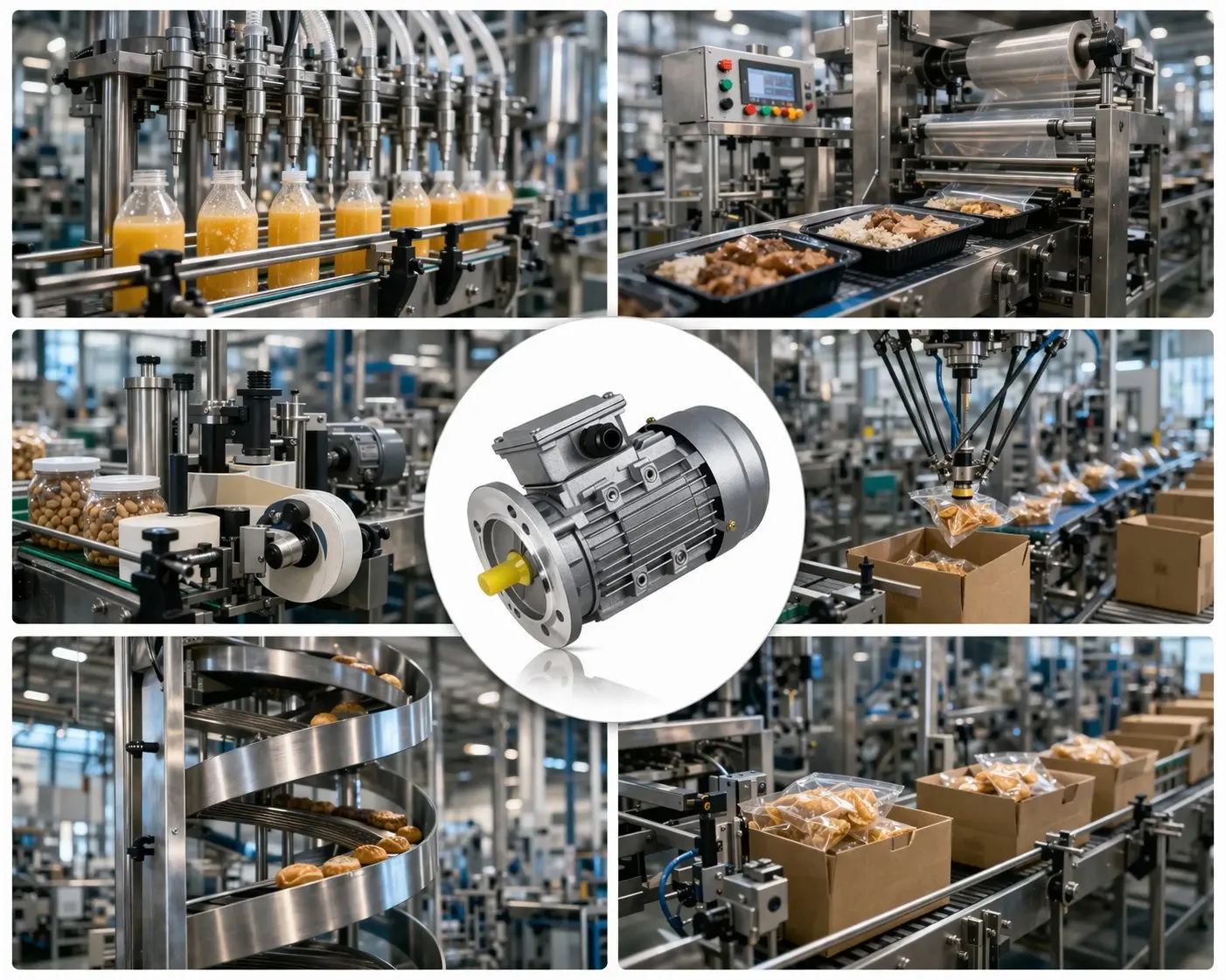
Food mixers create splash zones. Open-top mixers throw product droplets onto the motor housing during every batch. Even closed mixers with fitted lids leak product at the shaft seal during thick-product processing. And the CIP cleaning that follows every production run exposes the motor to the same alkaline-acid-sanitizer sequence described in our AC gear motor conveyor drive guide.
Our YE3 mixer motors ship with IP55 as standard, labyrinth shaft seals to prevent product splash from reaching the bearing cavity, and an optional 316L stainless-steel output shaft for installations using chlorine-based or peracetic acid sanitizers. The terminal box carries a silicone gasket rated for 200 degrees Celsius, and all external hardware (fan cover screws, nameplate, mounting bolts) is available in stainless steel for the harshest washdown environments. An anti-condensation heater strip, energized whenever the motor is de-energized, prevents moisture from condensing inside the winding cavity during overnight shutdowns in high-humidity production halls.
Motor Specifications for Mixing Duty
| Parameter | Specification |
|---|---|
| Recommended Series | YE3 (primary) / YVF2 (when low-speed hold is extended) |
| Power Range | 3 to 22 kW (depends on viscosity and vessel size) |
| Poles / Speed | 4-pole / 1450 rpm (6-pole / 960 rpm for ultra-low-speed mixing) |
| Protection | IP55 with labyrinth shaft seal |
| Insulation / VFD Rating | Class F, 1600 V peak |
| Shaft Material | Standard chrome-plated or 316L stainless |
| Cooling | IC0141 (DOL) or IC416 (VFD with extended low-speed mixing) |
| Starting Torque (Tst/Tn) | 2.0 to 2.5 times rated (DOL) / rated torque from 0 Hz (VFD) |
| Reducer | Planetary (thick products above 5.5 kW) / Worm gear (thin products) |
Compatible Brand Replacements
Brand names below are for cross-reference only. Our products are independently manufactured.
The YE3 replaces any IEC-frame electric motor on mixer drives: Siemens 1LE1, ABB M3BP, SEW DRN, Nord SK, WEG W22, LS Electric, Hyosung, Bonfiglioli, and Nidec. All frame dimensions follow IEC 60072 — same shaft height, foot bolts, and flange diameter. A sprocket and chain drive can bridge the motor-to-gearbox connection on installations with minor shaft offset.
Customer Results
“Our bakery runs four spiral dough mixers, each with a 1 500-liter bowl and 15 kW drive motor. The worm gear reducers were failing every 14 to 18 months from thermal degradation — the oil turned black and the worm wheel teeth showed visible pitting. We switched to YE3-160M-4 motors paired with planetary gearboxes. After 20 months of three-shift operation, the first planetary gearbox oil analysis came back clean — viscosity within spec, no metallic particles, no discoloration. The motor winding temperature stabilized 12 degrees lower than the old IE2 units due to the higher IE3 efficiency. The combined motor-and-gearbox upgrade paid for itself in avoided gearbox replacements within the first 16 months.”
Seo Jae-min, Maintenance Director
Industrial bakery, Pyeongtaek, Korea (Q2 2024)
“Sauce manufacturing — we make chili paste, soybean paste, and marinade sauces in 800-liter batch mixers. Viscosity ranges from 2 000 cP (thin marinade) to 80 000 cP (thick chili paste). The VFD-controlled YE3-132M-4 at 7.5 kW handles both extremes without stalling on startup. We run the thick paste batches at 25 Hz impeller speed and the thin marinades at 45 Hz, all from the same motor. Product splash during open-lid mixing has not caused a single moisture failure in 18 months, thanks to the IP55 sealing and stainless shaft.”
Nguyen Van Duc, Production Manager
Condiment manufacturer, Binh Duong, Vietnam (Q4 2024)
Mixer Motor FAQ
Get the Right Torque for Your Toughest Batch
Tell us your product viscosity, vessel size, and impeller type. We return a motor-and-gearbox selection — torque-verified for your thickest batch — within 24 hours.
Editor: Cxm