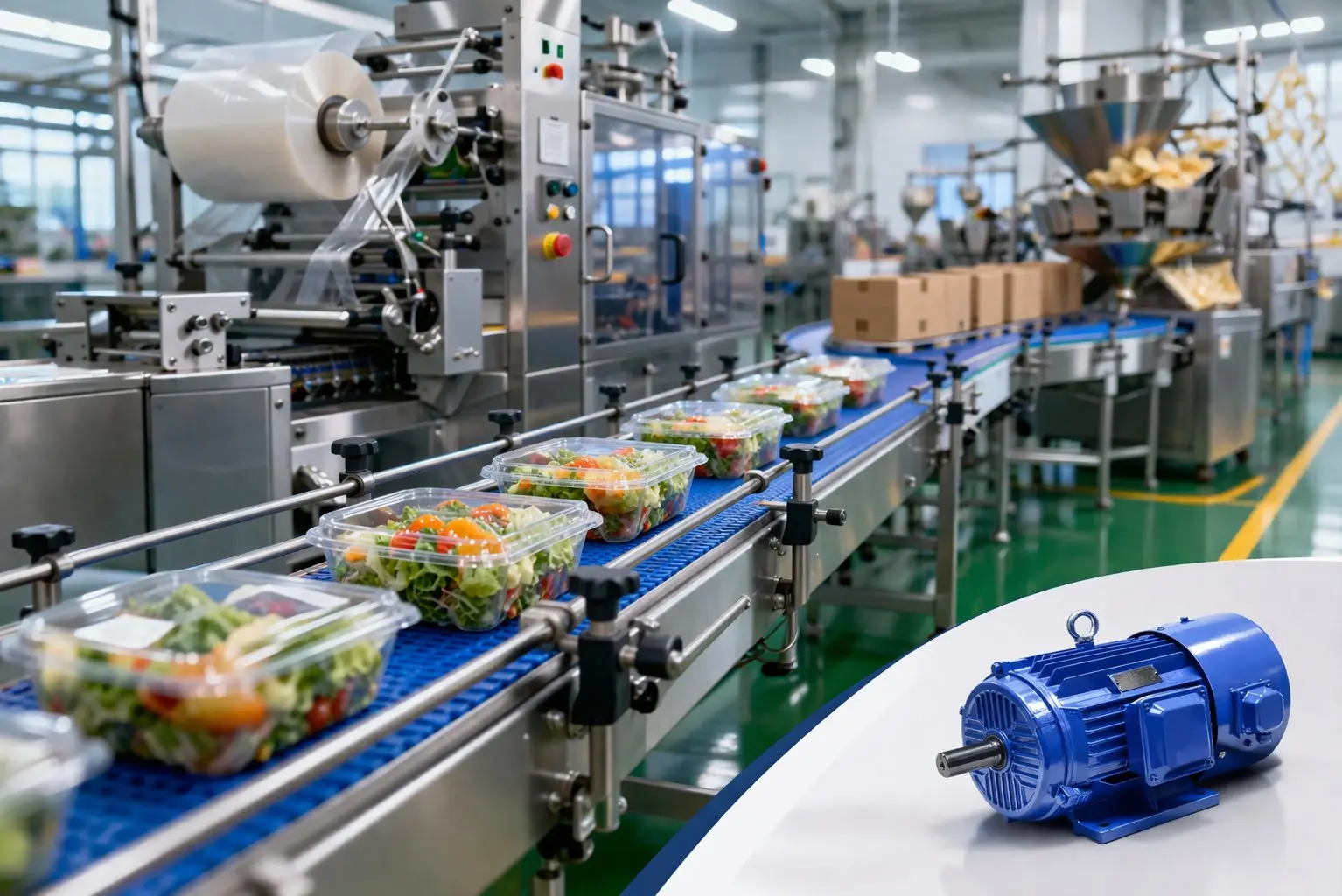
Retort Sterilization: The Hottest Motor Environment in Food Processing
A retort sterilizer — also called an autoclave or pressure cooker in industrial scale — processes sealed cans, glass jars, pouches, and trays at temperatures between 115 and 135 degrees Celsius under pressurized steam (1.5 to 3 bar gauge) for 15 to 90 minutes per cycle. The purpose is to eliminate all viable microorganisms inside the sealed package, achieving commercial sterility that allows the product to be stored at room temperature for months or years without refrigeration. Retort processing is the backbone of the canned food, ready-meal, pet food, and baby food industries.
Inside the retort vessel, a rotating basket or rocking mechanism agitates the product containers to ensure uniform heat penetration. The motor driving this mechanism operates either inside the pressure vessel (submerged in steam and condensate) or immediately outside the vessel wall, connected through a shaft penetration seal. In either case, the motor is exposed to temperatures that exceed the thermal rating of every standard induction motor specification on the market. The ambient temperature at the motor mounting point ranges from 60 to 95 degrees Celsius during the sterilization phase and drops to 30 to 40 degrees during the cooling and loading phases that follow.
Standard three phase motors carry an ambient temperature rating of 40 degrees Celsius. At 80 degrees ambient, the thermal margin available for internal temperature rise shrinks from 115 degrees (155 minus 40, for Class F insulation) to just 75 degrees — a 35 percent reduction in thermal headroom. Without specific engineering modifications, the motor insulation ages at 4 to 8 times its normal rate, and the motor fails within 12 to 24 months of retort service.
Our AC gear motor YE3 series with Class H insulation upgrade, high-temperature shaft seals, and epoxy-coated housings is specifically configured for retort duty — surviving the thermal cycling that destroys standard motors in under two years.

Steam Corrosion: How 121-Degree Saturated Steam Attacks Motor Components
Saturated steam at 121 degrees Celsius is not just hot air. It carries thermal energy at 2 700 kJ per kilogram — energy that condenses onto every surface cooler than the steam temperature, depositing a continuous film of near-boiling water. This condensate attacks motor components through three simultaneous mechanisms.
First, the condensate corrodes unprotected cast-iron surfaces. Standard gray iron develops a layer of rust (iron oxide) that flakes off over time, roughening the housing surface and degrading the thermal contact between the stator core and the housing bore. As this thermal interface degrades, the motor’s ability to transfer heat from the winding to the external cooling surface diminishes — creating a progressive thermal degradation loop where the motor runs hotter each month because its own corrosion products are insulating it from its cooling system.
Second, the steam penetrates standard rubber seals. Nitrile (NBR) O-rings and lip seals — the standard on most industrial motors — absorb moisture and swell in steam environments, losing their sealing force. Silicone and Viton (FKM) elastomers resist steam degradation, but they cost 3 to 5 times more than NBR. On a retort motor, the shaft seal, terminal box gasket, and cable gland seals must all be specified in steam-resistant elastomers — missing even one creates an ingress path for condensate.
Third, the thermal cycling itself causes mechanical fatigue. Every retort cycle takes the motor housing from 30 degrees (loading phase) to 85 to 95 degrees (sterilization) and back to 30 degrees (cooling) — a 60 to 65 degree temperature swing, 4 to 6 times per day, 300 days per year. That is 1 200 to 1 800 thermal cycles per year. The differential thermal expansion between the aluminum fan cover, the cast-iron housing, and the steel shaft creates micro-movement at every joint and seal interface, gradually opening gaps that admit moisture.
Our retort motor configuration counters all three mechanisms. The housing receives a high-build epoxy coating (200 to 300 microns DFT) that prevents iron-to-steam contact and maintains the thermal interface integrity for the life of the motor. All seals are Viton or silicone. And the terminal box uses a bolted, gasketed flange design with uniform clamping force — rather than the clip-on covers used on standard motors — to maintain seal compression through thousands of thermal cycles.
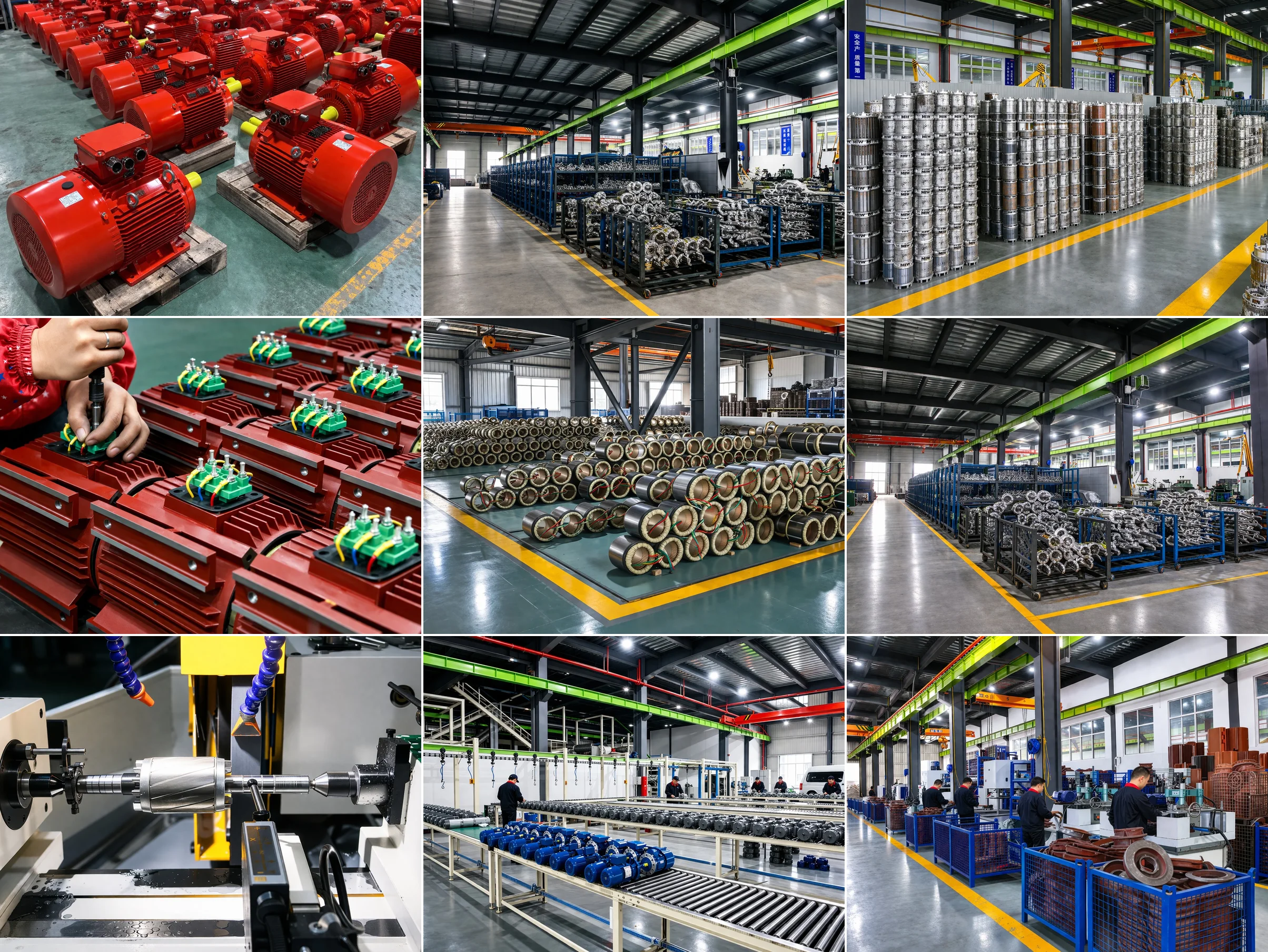
Retort Cycle Optimization: How Motor Speed Affects Sterilization Time
Inside the retort, the rotating basket or rocking frame moves the product containers to distribute heat evenly through the contents. Without agitation, the center of a large can (such as a 400 g canned soup) takes significantly longer to reach the target core temperature than the outer layers — the heat must conduct inward from the can wall through a viscous product that does not convect easily. Agitation forces convection currents inside the can, dramatically reducing the time required to bring the cold point to sterilization temperature.
The optimal agitation speed depends on the product properties, container geometry, and headspace volume. Too slow, and the convection benefit is minimal. Too fast, and delicate products (fruit pieces in syrup, whole green beans) suffer mechanical damage from the turbulence inside the container. Typical basket rotation speeds range from 5 to 15 rpm for gentle products and up to 25 rpm for robust products like pet food or thick soups.
A VFD-controlled motor allows the retort operator to adjust basket speed for each product recipe — running gentle products at 6 rpm and robust products at 20 rpm without changing any mechanical hardware. This speed flexibility can reduce total retort cycle time by 10 to 25 percent on products that benefit from faster agitation, directly increasing the number of retort cycles per day and the plant’s total throughput capacity.
The YE3 in 3 to 15 kW, 6-pole (960 rpm base speed), provides the high torque density needed for slow basket rotation. The 6-pole configuration delivers 50 percent more torque per frame size at low speed compared to a 4-pole motor, allowing a smaller gearbox ratio and a more compact drive train. A worm gear reducer with food-grade synthetic lubricant provides the final reduction from 960 rpm to the 5 to 25 rpm basket speed. For retorts that run at higher agitation speeds (above 20 rpm) or that require bidirectional rotation (rocking-type retorts), a planetary gearbox provides higher efficiency and lower backlash at the cost of a non-right-angle output arrangement.
Retort Motor Specifications
| Parameter | Specification |
|---|---|
| Recommended Series | YE3 with Class H insulation upgrade (mandatory for retort duty) |
| Power Range | 3 to 15 kW (depends on basket size and product weight) |
| Poles / Speed | 6-pole / 960 rpm (higher torque per frame than 4-pole) |
| Insulation | Class H (180 degrees C limit) — 25 degrees more headroom than Class F |
| Housing Treatment | High-build epoxy coating, 200-300 microns DFT, steam resistant |
| Seals | Viton (FKM) shaft seal + silicone terminal box gasket, rated 200 degrees C |
| Protection | IP55 with pressure-equalization breather for thermal cycling |
| Speed Control | VFD (recommended for recipe-based speed adjustment) |
| Reducer | Worm gear with food-grade synthetic oil (standard) / Planetary (rocking retorts) |
| Terminal Box | Bolted flange design (not clip-on) for thermal cycle seal integrity |

Compatible Brand Replacements
Brand names are for cross-reference only. Our products are independently manufactured.
The YE3 6-pole with Class H insulation replaces any IEC-frame electric motor currently on retort basket drives: Siemens, ABB, SEW, WEG, Nord, LS Electric, Hyosung, and Nidec. IEC frame dimensions ensure identical bolt patterns and shaft dimensions. For retort installations with sprocket and chain or gear coupling between motor and reducer, our shaft fits the existing coupling hub without modification.
Customer Results
“We operate 8 retorts processing canned tuna — 121 degrees Celsius, 75-minute cycles, 5 cycles per day. The previous motors lasted 14 to 20 months before insulation failure. After the second batch of replacements, we contacted Ever-Power and specified the YE3-132M-6 with Class H insulation, Viton seals, and epoxy-coated housing. That was 26 months ago. All 8 motors are still running. Insulation resistance testing at the last annual shutdown measured above 100 megohms on every unit. We estimate we have avoided 6 to 8 motor replacements (at 1.2 million KRW each) during this period.”
Choi Won-sik, Plant Engineering Manager
Canned seafood processor, Changwon, Korea (Q4 2023)
“We make retort pouch curry and ready meals. The basket agitation speed matters — too fast and the curry sauce separates, too slow and the center of the pouch stays undercooked. With VFD control on the YE3-100L-6, we dial the basket speed per recipe: 8 rpm for thick curry, 14 rpm for soup. The cycle time for thick curry dropped by 12 minutes compared to our old fixed-speed setup, which adds one extra retort cycle per day across our 4 retorts — roughly 1 600 more pouches per day in total throughput.”
Ahmad Faisal, Production Supervisor
Ready-meal manufacturer, Jeddah, Saudi Arabia (Q2 2025)

Retort Motor FAQ
Built to Survive What Kills Other Motors
Tell us your retort temperature, cycle count, basket size, and product type. We specify the insulation class, seals, coating, and drive configuration that will last 3 to 5 years instead of 12 months.
Editor: Cxm